 Free account
Free account Workbench plan
Workbench Plans
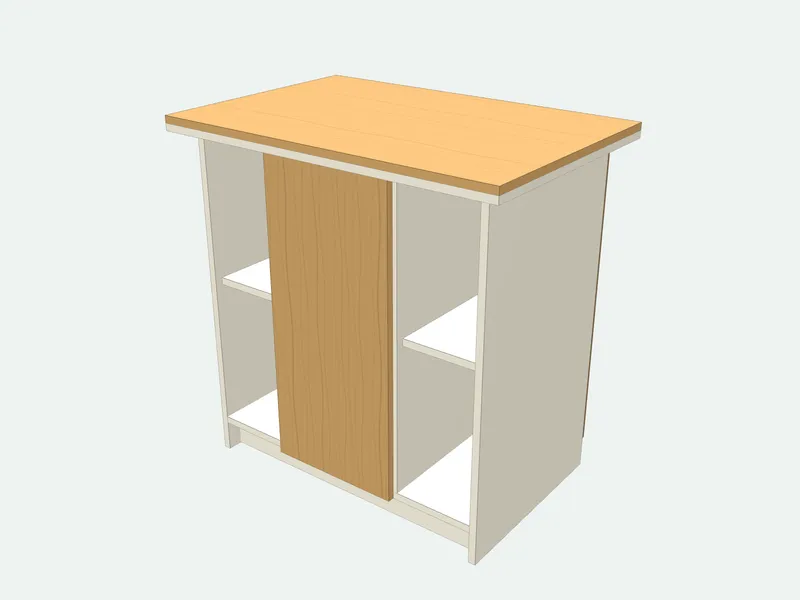
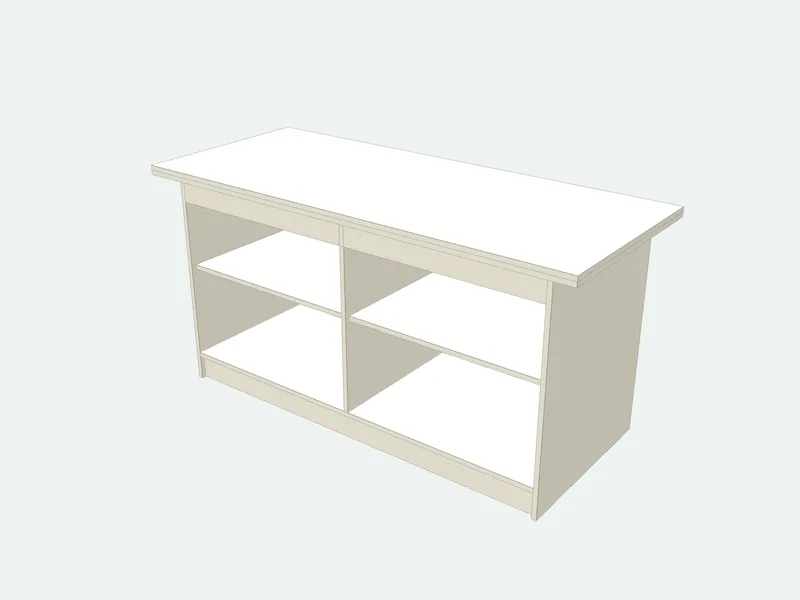
A sturdy shop workbench built entirely from sheet goods. The base is a cabinet with a full 18 mm back, a divider and shelves, so it cannot rack when you plane or saw; the top is two layers of board glued and screwed together, overhanging the base at the front and the ends so you can clamp work to it. Use it as a garage workbench, a tool bench or a woodwork bench in a workshop: a basic, solid work table with storage under it, at any length that fits your wall, up to a full 4 x 8 work table.
- Default size
- 1800 × 900 × 750 mm
- Parts
- 12 pieces · 8 sizes
- Sheets (2440 × 1220 mm (4 × 8 ft))
- 5 carcass
- Difficulty
- Intermediate
- Build time
- About 8 hours
- Edge band
- 16.9 m
Cut list (default size)
| Part | Qty | Length | Width | Thick. | Board | Edges |
|---|---|---|---|---|---|---|
| Top layer | 2 | 1800 | 750 | 18 | Carcass board 18 mm | |
| End panel | 2 | 864 | 700 | 18 | Carcass board 18 mm | |
| Back panel | 1 | 1564 | 764 | 18 | Carcass board 18 mm |
Sizes in millimetres; length runs along the grain. Edges: bold lines are banded.
5 more parts, the sheet layout and the cut order are in the full plan.Resize it to any size, print labels and save it in a project.Sign in free to open it
How it is built
- The top is two layers of board, glued and screwed from below, overhanging the base by 100 mm at each end and 50 mm at the front for clamping.
- The back is a full 18 mm panel screwed to the end panels, the bottom and the dividers: it is what stops the bench racking.
- Over 1800 mm of base, the bench gets a second divider, so no shelf is longer than about 850 mm.
- Screw the top layers on from below through the front rail, the back panel and the dividers, so the top can be replaced later.
Common mistakes
- Leaving out the back panel to save board: the bench will sway when you saw or plane.
- Building it at kitchen-counter height without checking: measure your wrist height first.
- Screwing down through the top: screw heads in the work surface damage tools and work.
Tools you need
- Track saw or circular saw with a guide
- Drill/driver
- Clamps
- Square
Frequently asked questions
What is a good workbench height?
About the height of your wrist when you stand with your arms down: 850–950 mm (34–37 in) for most people. Lower suits planing and assembly, higher suits fine work.
What board is best for the top?
MDF for the upper layer, because it is flat, smooth and cheap to replace, over plywood or MDF for the lower layer. Seal it with oil or varnish so glue does not stick.
How deep should a workbench be?
600–750 mm (24–30 in). Deeper benches hold more, but you cannot reach the back without leaning over.
Can I fit a vise?
Yes: the top overhangs the base by 100 mm at the ends and 50 mm at the front, so a front or end vise can be bolted under it.
Is a sheet-goods bench as strong as a wood work bench made from 2x4s?
Yes, for most work. The full back and the divider stop the base from racking better than wooden 2x4 legs, and the double top is flat and heavy. Hand-tool woodworkers who pound and plane hard often add a solid hardwood top later; the base stays the same. It is also an easy DIY build: straight cuts and screws.
Related guides
How to Build a WorkbenchHow to build a workbench for the garage or shop: the right height and size, a 2x4 frame or a plywood cabinet base, a double top, and no racking.How to Use a RouterHow to use a wood router: choosing bits, setting the depth, which way to feed, routing edges, dadoes and grooves with a guide, and using a router table safely.OSB vs PlywoodOSB vs plywood compared: strength, stiffness, moisture, weight and cost, and which is better for subfloors, roof and wall sheathing, shelving and furniture.