 Free
FreeBirch Plywood and Hardwood Plywood: Grades and Cores
Hardwood plywood is plywood with a face veneer of a hardwood such as birch, maple, oak or walnut over a core of wood veneers, MDF or particleboard. It is the standard board for cabinets and furniture: the face looks good and takes a finish, and the core decides how flat, heavy and strong the sheet is. Birch plywood is the most common and the cheapest of them.
Cores
| Core | What it is good for |
|---|---|
| Veneer core | Layers of wood veneer: lightest, strongest and best at holding screws, but may have voids and a slight bow. |
| MDF core | Flattest and smoothest face for paint and veneer; heavy, and screws in the edges need care. |
| Particleboard core | Cheap and flat, but heavy and the weakest at screws. |
| Combination core | Thin MDF layers under the faces over a veneer core: flat faces with veneer-core strength. A favourite for cabinets. |
Hardwood plywood grades
| Grade | Meaning |
|---|---|
| AA | Premium face, carefully matched veneers, for fine furniture. |
| A | Good face, matched for colour and grain: the usual cabinet grade. |
| B | Colour-matched but less carefully; small repairs allowed. |
| C, D | Sound faces with unmatched colour, small knots and repairs: for paint or hidden faces. |
| E | Larger repairs and defects: utility use. |
| Back grades 1–4 | 1 is sound with no open defects; 2 allows repairs; 3 and 4 allow open knot holes and splits. |
Common face species
| Face | Character |
|---|---|
| Birch | Light, fine grain, the cheapest hardwood face; paints well, stains unevenly. |
| Maple | Pale, hard and uniform; the smoothest painted finish. |
| Red and white oak | Strong open grain; takes stain evenly. Rift-sawn faces are straighter. |
| Walnut and cherry | Dark, rich colour for clear-finished furniture; expensive. |
Advantages
- Attractive hardwood face that takes paint, stain or clear finish
- Stiffer and lighter than MDF (veneer core)
- Holds screws well (veneer core)
- Sold in standard 4 × 8 ft sheets
Drawbacks
- Thin face veneer: sanding through it is easy
- Veneer-core sheets can have voids and be slightly bowed
- MDF and particleboard cores are heavy and weaker at screws
- Birch can blotch under stain
What it is used for
- Kitchen and bathroom cabinets
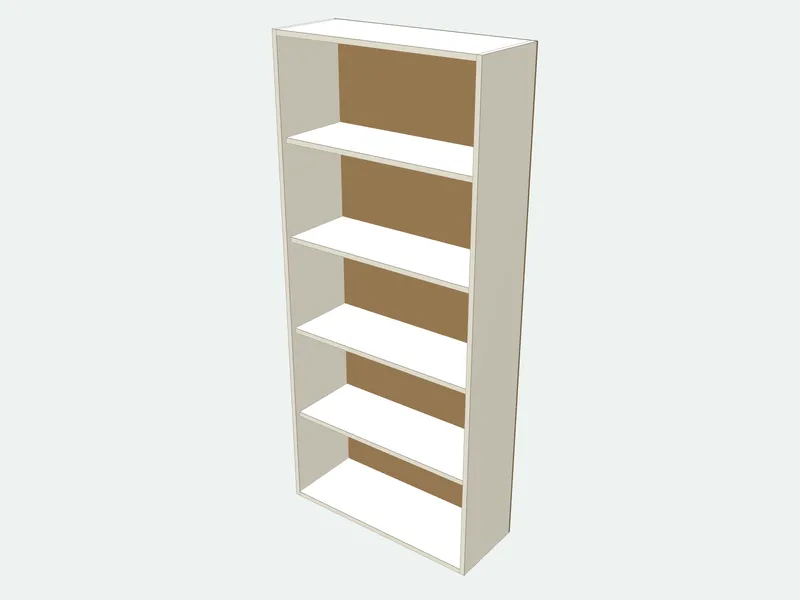
- Bookcases, built-ins and shelves
- Furniture with visible faces
- Drawer fronts and panels
Tips for working with Hardwood plywood
- For painted cabinets, maple or birch with a combination core gives the flattest, smoothest face.
- Use a pre-stain conditioner or a gel stain on birch to avoid blotches.
- Cut with a fine-tooth blade and tape the cut line to avoid tear-out on the face veneer.
- Hide the layered edges with edge banding or a solid wood strip.
Frequently asked questions
How does birch plywood look stained?
Birch plywood stained without preparation often turns blotchy, because the thin face veneer soaks up stain unevenly. Use a pre-stain conditioner or a gel stain, test on an offcut, and stay with light or mid tones.
What is the best plywood for cabinets?
3/4 in (18–19 mm) hardwood plywood with an A or B face, birch or maple, on a veneer or combination core. Use Baltic birch for drawers and 1/4 in plywood for backs.
Maple or birch plywood?
Maple is harder, more even in colour and slightly more expensive; it paints and finishes very smoothly. Birch has more figure and costs less, but blotches more easily under stain.
What does A-1 or B-2 mean?
The letter is the face grade (AA best, then A, B, C, D, E) and the number the back grade (1 best, to 4). A-1 is premium on both sides; B-2 is a good, common cabinet grade.
Sande plywood or birch plywood?
Sande is a lighter, softer tropical hardwood plywood, cheaper and fine for painted projects. Birch is harder and smoother, better for cabinets that take wear.
How thick is 3/4 birch plywood?
Usually 23/32 in (18.3 mm). Measure it before cutting dadoes or sizing parts.
Furniture plans to build
All plans →
Related guides
How to Build a CabinetHow to build a cabinet from plywood, MDF or melamine, step by step: size it, make the cut list, cut and edge band, drill, assemble the box and fit the doors.MDF vs PlywoodMDF vs plywood for cabinets, shelves and doors: strength, sag, screw holding, paint finish, moisture, weight and cost compared, with the right use for each.What Is Edge Banding?Edge banding is a thin strip glued over the raw edge of plywood, MDF or melamine. Learn the types (PVC, ABS, veneer), sizes and how to apply iron-on banding.