 Free
FreeWhat Is Hardboard? Tempered Hardboard and HDF Explained
Hardboard is a thin, dense sheet made of wood fibres pressed under heat and high pressure, often without added glue, usually 1/8 to 1/4 in (3 to 6 mm) thick. HDF (high-density fibreboard) is its modern, resin-bonded cousin. Both are used where a thin, stiff and cheap panel is needed: cabinet backs, drawer bottoms, pegboard and paint panels.
Types of hardboard
| Type | What it is and what it is for |
|---|---|
| Standard hardboard | Untreated, one smooth face and one textured (screen) back. Backs, templates, craft work. |
| Tempered hardboard | Treated with oil and heat: harder, stiffer and more water-resistant. Drawer bottoms, pegboard, workbench tops, signs. |
| Perforated hardboard (pegboard) | Tempered hardboard with 1/4 in holes on a 1 in grid for pegboard hooks. |
| HDF | Resin-bonded high-density fibreboard, smooth on both faces, often white or veneered. Cabinet backs and drawer bottoms in flat-pack furniture. |
| Tileboard / whiteboard | Hardboard with a glossy melamine or enamel face: wet-area walls and whiteboards. |
Hardboard vs HDF vs MDF
| Board | Density, thickness and use |
|---|---|
| Hardboard | About 900–1000 kg/m³, 3–6 mm (1/8–1/4 in): backs, drawer bottoms, pegboard. |
| HDF | About 800–1000 kg/m³, 2–8 mm: backs, drawer bottoms, laminate flooring cores. |
| MDF | About 700–800 kg/m³, 3–30 mm: carcasses, doors, painted furniture. |
Hardboard and HDF sold for furniture
| Board | Thicknesses | Common sheet sizes |
|---|---|---|
| HDF | 3 mm, 4 mm, 6 mm | 2440 × 1220, 2800 × 2070 |
| White-faced HDF (backs) | 3 mm, 4 mm | 2800 × 2070, 2440 × 1220 |
| Hardboard | 3.18 mm, 6.35 mm | 4×8 ft, 2440 × 1220 |
| Pegboard | 3.18 mm, 6.35 mm | 4×8 ft, 2×4 ft |
Hardboard and HDF thicknesses
Hardboard and HDF is sold in 3 mm (1/8"), 3.18 mm (1/8"), 4 mm (3/16"), 6 mm (1/4"), 6.35 mm (1/4"). For furniture carcasses and doors, 16–19 mm is standard; thin sheets are for backs and drawer bottoms.
Hardboard and HDF sheet sizes
- 2440 × 1220 mm (96 1/16" × 48 1/16")
- 2800 × 2070 mm (110 1/4" × 81 1/2")
- 4×8 ft (2438 × 1219 mm)
- 2×4 ft (1219 × 610 mm)
Weight of a 2440 × 1220 mm sheet
At a typical density of 850–1000 kg/m³:
| Thickness | Weight per sheet |
|---|---|
| 3 mm | 8–9 kg (18–20 lb) |
| 3.18 mm | 8–9 kg (18–20 lb) |
| 4 mm | 10–12 kg (22–26 lb) |
| 6 mm | 15–18 kg (33–40 lb) |
| 6.35 mm | 16–19 kg (35–42 lb) |
Advantages
- Thin, dense and stiff for its thickness
- Cheap
- Smooth face that paints well
- A nailed-on back squares a cabinet
Drawbacks
- Not structural on its own
- Edges cannot hold screws
- Standard hardboard swells if it gets wet
- Only one smooth face on many sheets
What it is used for
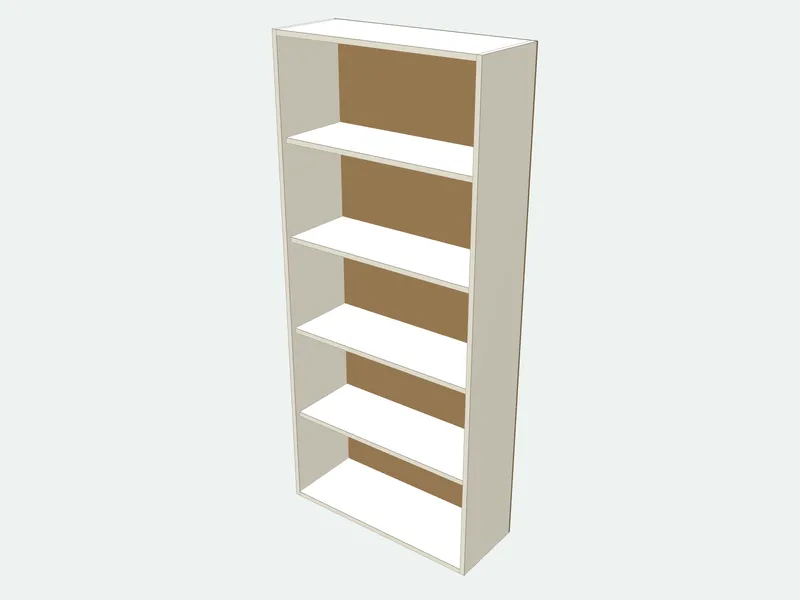
- Cabinet, bookcase and wardrobe backs
- Drawer bottoms
- Pegboard tool walls (perforated hardboard)
- Underlayment, templates and jigs
- Art panels and whiteboards (tileboard)
- Exterior siding (special siding grades)
Tips for working with Hardboard and HDF
- Use the back panel to square the cabinet: measure the diagonals before nailing.
- White-faced HDF gives a clean inside without painting.
- Prime hardboard with an oil-based or shellac primer before water-based paint, or the fibres raise.
- Cut it with a fine-tooth blade, smooth face up on a table saw.
Frequently asked questions
What is tempered hardboard?
Hardboard soaked in oil and baked, which makes it harder, stiffer and more water-resistant than standard hardboard. Use it for drawer bottoms, pegboard and anything that takes wear.
What is the difference between hardboard and MDF?
Both are made of wood fibres, but hardboard is much denser (about 900–1000 kg/m³ against 750) and thinner, usually 3–6 mm. MDF comes thicker and is used for carcasses and doors; hardboard for backs and bottoms.
Is HDF the same as hardboard?
Nearly. HDF is bonded with resin and made in a dry process; traditional hardboard is pressed wet and held together mainly by the wood’s own lignin. In use they are interchangeable for backs and drawer bottoms.
Can you paint hardboard?
Yes. Sand lightly, prime with an oil-based or shellac primer, then paint. Tempered hardboard needs the primer most, because of its oily surface.
What thickness for a cabinet back?
1/8 in (3 mm) for small cabinets, 1/4 in (6 mm) for tall wardrobes or when you hang the cabinet through the back.
Furniture plans to build
All plans →
Related guides
Cabinet Parts Names ExplainedNames of kitchen cabinet parts explained with sizes: sides (gables), bottom, stretchers, toe kick, back, shelves, doors and drawer parts. With a free cut list.MDF vs PlywoodMDF vs plywood for cabinets, shelves and doors: strength, sag, screw holding, paint finish, moisture, weight and cost compared, with the right use for each.